Strong Communities Start With Supported Parents

A Rural School District’s Guide to Child Sexual Abuse and Human Trafficking Prevention
October 21, 2026

A new school year means new backpacks, new class lists, and a long list of decisions competing for your attention. Here’s one worth moving to the top: enrolling your school counselor in PCAU’s Train-the-Trainer program. It is endorsed and paid for by USBE, and equips your staff to bring prevention education to every K–6 student in your schools.
Here’s what the Train-the-Trainer program is and how to get funding to cover costs.
Schedule Today!
In October 2025, the Utah State Board of Education named Prevent Child Abuse Utah the statewide primary provider of child sexual abuse and human trafficking prevention education for grades K–6. That means every public and charter elementary school in Utah has access to this curriculum at no cost to the LEA, funded through legislative changes to Utah’s Child Sexual Abuse Prevention Law.
PCAU’s approved curriculum is taught by a school counselor or other school professional with a master’s degree who has completed the training. Once trained, these professionals can begin teaching the material immediately.
Inside a Train-the-Trainer Session
During the one-day, in-person training, attendees learn the Protective Factors Framework. This framework grounds the material in research before counselors teach a single lesson, helping them understand the “why” behind each lesson, not just the script.
Sessions cover five protective factors:
- Concrete supports
- Social connections
- Social and emotional competence
- Knowledge of child development
- Resilience
Each factor is paired with a guiding principle that shapes how your staff works with children: being trauma-informed, relationship-based, strength-based, culturally responsive, and self-aware.
This matters because school counselors and educators are often the first adults a child turns to. PCAU’s Train-the-Trainer program teaches attendees to recognize how trauma shows up in a classroom, build relationships with students and families, and respond calmly and correctly if a student discloses abuse. Much of that comes down to trust, which is built long before the first lesson begins.
The Curriculum: What Your Students Will Learn in the Classroom
What will counselors be teaching? PCAU’s curriculum builds across four core concepts, with lessons adapted to students’ developmental levels from kindergarten through sixth grade.
Body safety comes first. Students learn that their bodies belong to them. A simple thumbs-up and thumbs-down activity shows that they can say no to unwanted physical touch and attention. A welcome hug is a thumbs-up; unwanted touching, even from someone familiar, is a thumbs-down. For older students, this extends to personal space and online requests.
Next, students learn the safety rules. Younger students learn a safety rules song with the lyrics, “listen to the uh-oh feeling, say no, go tell.” Older students learn to “recognize, resist, and report abuse.” These simple rules help students recognize their feelings, understand that they can refuse uncomfortable or abusive behavior, and identify trusted adults they can turn to for help.
Recognizing abuse is another core concept. Older students learn statistics about child abuse and the five types of abuse. Counselors are equipped to teach the material for each grade and respond correctly if a student discloses abuse.
Finally, students learn about trusted adults. Students are encouraged to identify five trusted adults they could turn to for help. That number is important because students are encouraged to keep telling until someone believes them.
Prevent Child Abuse Utah’s elementary school curriculum broken out by grade and topics covered:
Is Funding Available?
Because Prevent Child Abuse Utah is the primary provider of child sexual abuse and human trafficking prevention education and receives USBE funding, the Train-the-Trainer program and use of PCAU’s curriculum are available at no cost to Utah’s public LEAs.
USBE offers the Alternative Provider Choice grant to cover staff time for training, communication with parents, teachers, and administrators, and parent nights, as well as materials and preparation.
If your LEA is interested in the Choice grant, contact Mindy Elliot at USBE at mindy.elliot@schools.utah.gov. If you’d like help estimating staff time or other costs, contact Paige Barnson at pbarnson@pcautah.org. Paige is happy to walk you through the time and costs associated with implementing the curriculum.
Parents Are the Primary Protectors of Their Children
During training, counselors learn how parents can review the curriculum in advance, attend the school presentation, and ask questions directly. Families receive notification before students receive instruction, and PCAU provides notification templates. Parents may decide that the presentation is not beneficial for their child.
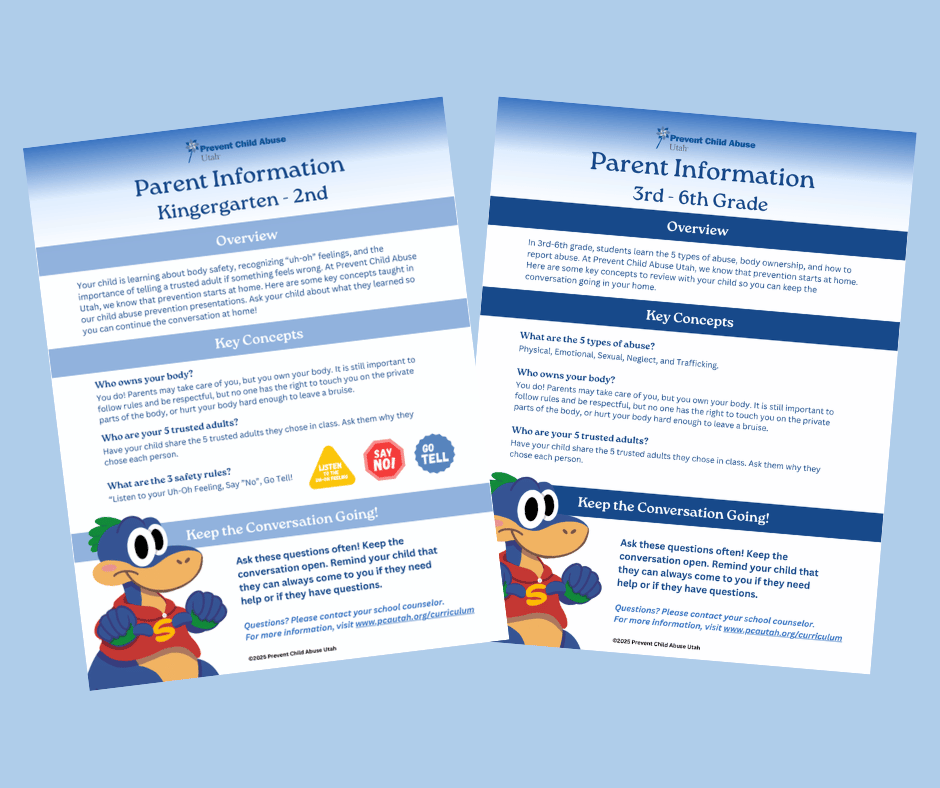
Informational handouts are sent home so families can discuss the topics students learn at school. Trainees receive PDF handouts to keep available whenever they teach in a classroom.
Parent nights give parents a clear, low-pressure way to engage before the curriculum reaches their child’s classroom. Prevent Child Abuse Utah’s education specialists can attend a parent night virtually to help answer questions. Another option is for PCAU to host the parent night for your LEA.
Resources include a slide deck, FAQs, and printed take-home materials for families. A parent information session is easy to add to an event you’re already hosting, such as Back-to-School Night or a PTA meeting.
How to Get Your District Scheduled
Email Paige Barnson at pbarnson@pcautah.org to get your district on the calendar. To help move things along quickly, include three things in your first email:
- A rough estimate of how many school counselors you’d like trained
- Whether you’d like help applying for grant funding
- Your preferred training dates
Enrollment is open now for both the 2026–2027 and 2027–2028 school years. If your calendar is already set, you can reserve next year’s spot now.

Three Things to Do This Week
- Check your district’s records to see whether Train-the-Trainer has already been completed this cycle.
- Email pbarnson@pcautah.org with an estimate of how many counselors you’d like trained, your preferred training dates, and whether you’d like help applying for grant funding.
- Share this with another administrator or district leader who cares about prevention education.
Listen to how trusted adults could have made a difference in Deondra Brown’s life.
Thank You for Keeping Your Students Safe
Thank you to all the administrators making room in their already full calendars. Thank you to the counselors who sit with children the moment they decide to tell. Thank you to every Train-the-Trainer graduate bringing prevention education into a Utah classroom this year.
Every lesson in the curriculum points back to the same idea: every child needs at least one trusted adult they feel safe talking to. That adult can be a parent, teacher, counselor, coach, or administrator who helps build a culture where children know they’ll be believed.
Scheduling this training helps ensure that your schools have adults prepared to teach prevention skills, listen when students speak up, and respond when they need help.
If something a student shares with your staff ever concerns you, trust that instinct and act on it. Utah’s Child Abuse Reporting Hotline: 1-855-323-3237.
Visit pcautah.org/donate to support prevention education in classrooms across Utah.